Discover your Chinese zodiac and Chinese New Year、Chinese Calendar in this place

The Chinese Zodiac Calendar: Your Complete Guide to the 12-Year Cycle of Destiny and Time
For the Western mind, a calendar is a utilitarian grid, a tool for scheduling meetings and marking holidays. But in the heart of traditional Chinese culture, a calendar is something far more profound: a living, breathing map of cosmic energy, a narrative of time written in the language of animals and elements. This is the Chinese Zodiac Calendar, a sophisticated system that weaves together astronomy, philosophy, and destiny into a 12-year cycle known as the Shengxiao. If you’ve ever wondered why the “Year of the Rabbit” feels different from the “Year of the Dragon,” or how your birth year’s animal might whisper truths about your personality, you’re touching the surface of a deep and ancient wisdom. At ChineseFate, we believe this system is not mere superstition but a unique cultural framework for understanding personality, timing, and our place in the natural world’s rhythms. This guide is designed for the curious Western reader, translating this complex philosophy into accessible insights for modern life.
Unlike the static, solar-based Gregorian calendar, the Chinese Zodiac calendar is lunisolar, synchronizing with both the moon’s phases and the sun’s journey. This creates a dynamic, shifting system where New Year floats between January and February, and each year is governed by a specific animal sign and one of the Five Elements (Wood, Fire, Earth, Metal, Water). The result is a 60-year “sexagenary cycle” of unique combinations, making 2026’s “Year of the Fire Horse” fundamentally distinct from 1966’s “Year of the Fire Horse.” This isn’t just about your birth sign; it’s about the energetic quality of *time itself*, offering a lens to understand collective trends, optimal timing for endeavors, and personal fortune.
🐲 Zodiac Calculator
Enter your birth year to discover your Chinese zodiac animal
Beyond Animals: The Architecture of the Lunisolar Calendar
To truly grasp the Chinese Zodiac calendar, we must first dismantle the Western assumption that it’s simply “12 animals for 12 years.” The animal is the charismatic mascot, but the underlying structure is a masterpiece of ancient interdisciplinary science. The traditional Chinese calendar, or the “agricultural calendar” (農曆, Nónglì), is a precise mathematical model that reconciled the moon’s 29.5-day cycle (a lunar month) with the sun’s 365.25-day cycle (a solar year). An extra month is inserted roughly every three years (a leap month) to keep the seasons aligned. Your Chinese Zodiac sign is determined by the lunar year of your birth, not the January 1st date.
This lunisolar foundation means the calendar is inherently tied to agriculture, seasons, and celestial events. Each of the 24 solar terms (like “Spring Equinox” or “Great Cold”) marks a specific astronomical position and corresponding earthly energy. The Zodiac calendar overlays the 12 Earthly Branches (represented by the animals) onto this seasonal flow. For instance, the Tiger (Yin) corresponds to the first lunar month, around February, when yang energy begins to stir after winter’s depth. This creates a calendar that doesn’t just measure time but *qualifies* it, telling you if the energy of a given day, month, or year is for bold initiation (Dragon), careful consolidation (Ox), or social connection (Monkey).
Chinese Zodiac Calendar vs. Western Gregorian Calendar: A Structural Comparison
| Feature | Chinese Zodiac (Lunisolar) Calendar | Western Gregorian (Solar) Calendar |
|---|---|---|
| Primary Basis | Cycles of the Moon and Sun | Cycle of the Sun only |
| New Year Date | Variable (Jan 21 – Feb 20) | Fixed (January 1) |
| Core Unit of Long-Term Time | 12-Year Animal Cycle / 60-Year Elemental Cycle | Century, Millennium |
| Philosophical Underpinning | Cyclical, Holistic, Energetic (Yin-Yang, Five Elements) | Linear, Quantitative, Secular |
| Primary Cultural Function | Guide for agriculture, destiny analysis, festival timing, life planning | Civil administration, international scheduling, historical record |
| View of Time | Qualitative (time has “flavor” and “energy”) | Quantitative (time is a neutral resource) |
The 12 Earthly Branches: Personality Archetypes in the Zodiac Cycle
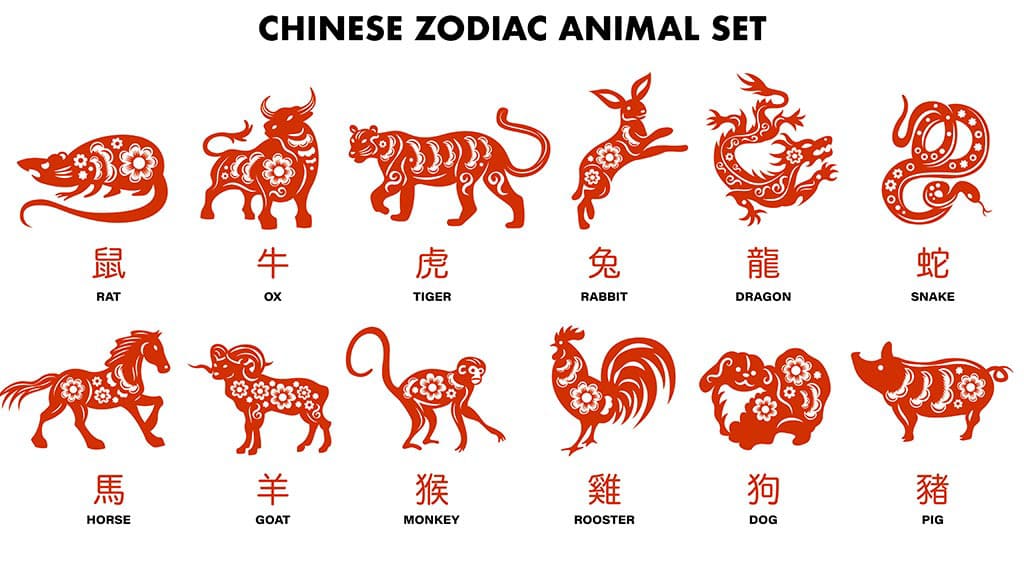
The heart of the popular imagination lies with the 12 animal signs: Rat, Ox, Tiger, Rabbit, Dragon, Snake, Horse, Goat, Monkey, Rooster, Dog, and Pig. According to legend, the Jade Emperor called for a race, and the order the animals finished determined their place in the calendar. Beyond the charming myth, each animal is a symbolic vessel for a cluster of personality traits, strengths, challenges, and life paths. At ChineseFate, we analyze these as cultural archetypes—deep-seated patterns of behavior that resonate across generations.
For example, the Ox (second in the cycle) embodies diligence, stability, and methodical strength. In a Western context, think of the dependable Capricorn or the ISTJ personality in MBTI. The Dragon, fifth in the cycle, is the charismatic, visionary, and lucky innovator—akin to a Leo with entrepreneurial spirit. Understanding your sign is the first step in a deeper Chinese astrology reading, but it’s crucial to remember the calendar assigns the sign to the *year*, influencing your innate nature. The month, day, and hour of your birth (your “Four Pillars of Destiny”) add further layers of specificity, much like a Western natal chart with sun, moon, and rising signs.
📅 Daily Horoscope
Select your zodiac sign to get personalized predictions for today
♈
Aries
♉
Taurus
♊
Gemini
♋
Cancer
♌
Leo
♍
Virgo
♎
Libra
♏
Scorpio
♐
Sagittarius
♑
Capricorn
♒
Aquarius
♓
Pisces
The Zodiac Animal Matrix: Traits, Modern Correlates, and Life Paths
| Zodiac Animal | Core Archetype | Key Strengths (Western Analogy) | Potential Challenges | Suggested Modern Life Path |
|---|---|---|---|---|
| Rat (Zi) | The Quick-Witted Survivor | Adaptable, charming, resourceful (Entrepreneurial Spirit) | Can be opportunistic, hold grudges | Sales, finance, diplomacy, crisis management |
| Ox (Chou) | The Dependable Builder | Patient, reliable, honest (The Rock/ISTJ) | Stubborn, resistant to change | Engineering, project management, agriculture, skilled trades |
| Tiger (Yin) | The Courageous Pioneer | Brave, confident, competitive (Natural Leader/ENTJ) | Impulsive, can be authoritarian | Leadership roles, military, athletics, startup founder |
| Rabbit (Mao) | The Diplomatic Peacemaker | Kind, artistic, discreet (The Diplomat/INFP) | Overly cautious, avoids conflict | Counseling, arts, design, human resources |
| Dragon (Chen) | The Charismatic Visionary | Energetic, lucky, innovative (The Visionary/ENFP) | Arrogant, impatient with details | CEO, creative director, performer, thought leader |
| Snake (Si) | The Wise Strategist | Intuitive, analytical, graceful (The Strategist/INTJ) | Secretive, can be distrustful | Research, analyst, philosopher, luxury brand manager |
| Horse (Wu) | The Free-Spirited Adventurer | Independent, cheerful, hardworking (The Adventurer/ESTP) | Restless, can be tactless | Travel industry, sales, journalism, freelance work |
| Goat (Wei) | The Creative Empath | Gentle, artistic, compassionate (The Artist/ISFP) | Pessimistic, indecisive | Artist, musician, therapist, pediatric care |
| Monkey (Shen) | The Ingenious Problem-Solver | Witty, inventive, sociable (The Inventor/ENTP) | Mischievous, can be manipulative | Technology, comedy, marketing, investigative work |
| Rooster (You) | The Meticulous Organizer | Observant, hardworking, punctual (The Inspector/ESTJ) | Critical, perfectionist | Law, administration, journalism, personal styling |
| Dog (Xu) | The Loyal Guardian | Loyal, responsible, righteous (The Defender/ISFJ) | Cynical, anxious | Social work, law enforcement, nursing, nonprofit leadership |
| Pig (Hai) | The Generous Hedonist | Generous, diligent, enjoys life (The Epicurean/ESFJ) | Naive, materialistic | Hospitality, culinary arts, finance (wealth management), charity |
The Five Elements: The Dynamic Engine of the 60-Year Cycle
If the animals are the “what,” the Five Elements (Wu Xing) are the “how.” This is where the Chinese Zodiac calendar transcends simple personality typing and becomes a dynamic model of change and interaction. Wood, Fire, Earth, Metal, and Water are not literal substances but metaphors for phases of energy: growth (Wood), expansion (Fire), stability (Earth), contraction (Metal), and conservation (Water). Each zodiac year is also influenced by one of these elements, creating a 60-year cycle (12 animals x 5 elements).
This elemental layer explains why two people born in the “Year of the Rat” can be so different. A “Wood Rat” (1984) may be more idealistic and growth-oriented, while a “Water Rat” (1972) might be more adaptable and communicative. The element also governs the overarching mood of a year. The upcoming 2026 Year of the Fire Horse, for instance, promises a year of dynamic action, rapid change, and passionate energy—a stark contrast to the more reflective and diplomatic energy of 2023’s Water Rabbit year. Understanding this cycle allows for strategic life planning. Launching a bold, fiery venture might find more fertile ground in a Fire year, while consolidating finances and building systems is favored in a Metal or Earth year.
Practical Application: Using the Zodiac Calendar for Modern Life Planning
How can a Westerner, living by Google Calendar, use this ancient system? The key is to shift from a purely linear planning model to one that incorporates cyclical awareness. Here are practical, non-magical applications:
Career and Business Timing: Look at the elemental quality of the year. A Fire year (like 2026) is excellent for launching marketing campaigns, starting a new sales drive, or rebranding—anything requiring energy and visibility. A Metal year is better for restructuring, implementing new software systems, or focusing on precision and quality control. If you’re a Tiger (a natural pioneer), knowing your “Ben Ming Nian” (Zodiac Year of Birth, considered challenging) might prompt you to avoid risky career moves that year and focus instead on consolidation and self-care.
Understanding Relationships (Personal & Professional): The calendar offers a framework for compatibility. Certain signs naturally harmonize (e.g., Rat and Dragon, Rabbit and Goat), while others clash (e.g., Rat and Horse, Rooster and Rabbit). This isn’t a destiny decree but a useful lens. If you’re a direct, fast-moving Horse managing a meticulous, detail-oriented Rooster, understanding these inherent stylistic differences can improve communication. It’s akin to using personality typing in team-building workshops.
Cultural Literacy and Travel: Planning a business trip or vacation to Asia during the Lunar New Year? Understanding it’s the Year of the Fire Horse tells you the public mood might be energetic and restless. Gifting a business associate? Knowing their zodiac sign can inform a thoughtful, culturally resonant gift (e.g., art featuring their animal for a Rabbit, a bold innovation book for a Dragon).
🎲 Lucky Numbers
Get your fortune numbers for today
The Zodiac Calendar in Cross-Cultural Perspective: Beyond Horoscopes
To the Western eye, the Chinese Zodiac calendar is often lumped with astrology. While both are divinatory systems, their philosophical roots differ significantly. Western astrology is primarily spatial, based on the position of planets *at a moment in time* relative to the zodiac constellations. Chinese zodiacal thought is fundamentally *temporal*, based on the cyclical passage of time itself (years, months, days, hours) and its qualitative energy.
A more apt comparison might be to other cyclical models of history and human development, like the generational theory of Strauss and Howe or even the economic Kondratiev waves. The 12-year animal cycle and 60-year elemental cycle can be observed in broader social moods. For instance, periods dominated by “Fire” elements often coincide with cultural revolutions, technological leaps, and social unrest, while “Earth” periods favor stability, infrastructure building, and consolidation. This perspective elevates the Zodiac calendar from a personal fortune-telling tool to a fascinating model for analyzing long-term historical and social trends.
Comparative Analysis: Chinese Zodiac Calendar & Western Systems
| System | Core Basis | Primary Focus | Strength for Modern Application | Limitation |
|---|---|---|---|---|
| Chinese Zodiac Calendar | Cycles of Time (Year/Month/Day/Hour) & Elemental Phases | Energetic quality of time, innate character, cyclical destiny | Excellent for long-term trend awareness, understanding innate temperament, cultural timing | Less granular on day-to-day psychological nuance without full “Four Pillars” analysis |
| Western Natal Astrology | Planetary positions at exact birth moment | Individual psychological blueprint, internal drives, relationship dynamics | Deep dive into personal psychology, motivations, and interpersonal chemistry | Can be overly complex; less emphasis on collective, yearly energy shifts |
| MBTI / Personality Typing | Self-reported cognitive preferences | Work style, communication, decision-making processes | Practical, immediately applicable for team dynamics and career counseling | Static model; doesn’t account for change over time or cultural conditioning |
| Generational Theory (e.g., Boomers, Gen Z) | Shared historical experiences of a birth cohort | Broad societal values, consumer behavior, political attitudes | Powerful for marketing, sociology, and understanding large-scale social change | Over-generalizes individuals; ignores deeper archetypal or cyclical patterns |
Common Misconceptions and How to Navigate Them Authentically
As interest in Eastern wisdom grows in the West, so do simplifications. One major misconception is reducing your sign to a handful of generic traits found in a placemat at a Chinese restaurant. Your zodiac animal is just one of four pillars. A deeper reading at ChineseFate considers the interplay of all pillars, much like a symphony where the year sign is the main melody, but the month, day, and hour signs provide harmony, rhythm, and bass.
Another error is fatalism. The Chinese Zodiac calendar outlines tendencies and potentials, not unchangeable fate. It suggests that a person born in a Water year may have natural diplomatic skills, but whether they develop them is up to free will and environment. The system is best used as a guide for self-awareness and strategic action, not a deterministic script. Finally, not every cultural tradition associated with the calendar (like specific taboos) needs to be adopted literally by Westerners. The goal is to understand the underlying principle—such as respecting cyclical transitions—and apply it in a way that is meaningful to your own life context.
Your Journey with the Cycle Begins Now
The Chinese Zodiac calendar is a invitation to see time not as a straight line rushing toward an end, but as a sacred circle, a spiral of returning seasons and evolving energies. It connects the personal to the cosmic, suggesting that the year you were born imprints a certain flavor on your soul, and that each passing year brings a unique energy you can align with or navigate. In a modern world obsessed with speed and linear progress, this ancient system offers a wise counterpoint: a reminder to sometimes go with the current of the time, to plant in spring and harvest in autumn, and to understand our personalities as part of a grand, archetypal story.
Your exploration starts with discovery. What is your Chinese Zodiac animal sign? What element governed your birth year? From there, you can delve into the rich layers of compatibility, yearly forecasts, and the profound wisdom of the lunar calendar. At ChineseFate, we provide the tools and culturally accurate interpretations to guide you. Use this knowledge not to predict a fixed future, but to understand your inherent strengths, recognize the opportunities in the turning seasons of time, and ultimately, write your own more conscious and harmonious story within the great cycle.